Historical events are not fixed on a linear timeline; they behave volumetrically, spilling into the present as social conditions that echo their original violences. In South Africa, racialised policies under the Group Areas Act controlled how people moved, lived, and belonged in the city. Contemporary homelessness reverberates with this history of forced displacement, as communities were removed from homes and economic opportunities, leaving lasting spatial and social dislocation. The removal of people from economic centres continues to structure homelessness as a colonial afterlife of apartheid-era dispossession. This paper/screen dance proposes the praxis-led screendance We Made it to Morning as a form of choreographic activism that exposes this connection. Screendance collapses temporal boundaries, revealing links between past displacement and present homelessness. Set in South End, Gqeberha—a site marked by forced removals—the work draws on psychogeography, particularly the Situationist concept of dérive, to follow Maria, a paradigmatic figure of displacement. Using archival material from the South End Museum, her story juxtaposes the demolition of her home with her present-day homelessness. Through embodied movement across this landscape, the film becomes a disruptive presencing. Dancing in spaces of past removal reactivates place, positioning the body as a site of resistance and restitution.
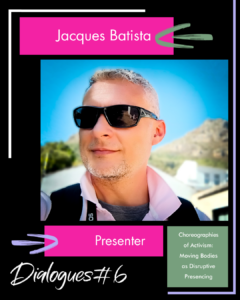
Jacques Batista is a photographer and screendance videographer who creates intimate visual experiences through movement and stillness. His work has featured at the National Arts Festival and on its vFringe, JOMBA! Digital Open Horizons, Toyota Woordfees and the LBMS Conference 2025 in the United States. In addition to training in acting and physical theatre at Rhodes University, Batista’s praxis-led research in screendance applies the Laban Movement Analysis framework to the editing process towards the Laban Institute of Movement Studies’ CMA qualification.