KEYNOTE ADDRESS:
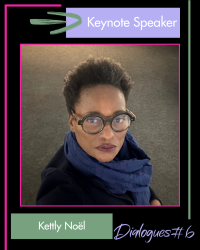
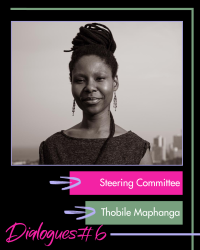
Kettly Noël (Haiti and Mali) in dialogue with Thobile Maphanga

THIS BODY THAT REMEMBERS!

Biographies

Kettly Noel

Kettly Noël is a Haitian-born choreographer, performer, and cultural practitioner whose work moves between creation, transmission, and critical engagement with contemporary realities. While she gained wider public recognition through her striking role as Zabou in Timbuktu (2014), directed by Abderrahmane Sissako, her primary artistic language remains choreography — a space where the body becomes both archive and site of resistance. Raised in Haiti, she was drawn to dance at an early age. Her artistic journey later expanded across Africa and Europe, deeply shaped by social, political, and cultural contexts. In 2001, she co-founded Donko Seko, a choreographic centre in Bamako, Mali, alongside the Dense Bamako Danse festival. This initiative was conceived as a platform for training and supporting dancers in direct relation to lived realities, fostering a contemporary practice rooted in experimentation and openness beyond fixed forms. Her choreographic works often emerge from confrontation with violence, memory, and the complexities of identity. Early pieces such as Tichelbé (2002) established her as a singular voice within contemporary African choreography, exploring tensions between bodies, genders, and power structures. Her work has been presented on major international stages: Documenta 14 (Athens), the Venice Biennale, Montpellier Danse, Chaillot – Théâtre National de la Danse, La Villette, the Lyon Dance Biennale, the Festival d’Avignon (In), Tanz im August, Wiener Festwochen, Romaeuropa, among others.

Foundation’s fellowship in 2021 in Cassis, France. She was curator for performance in public spaces at the Serendipity Festival, Goa in 2024. In India, she was awarded the Bismillah Khan award for her choreographic contribution by the Ministry of Culture, India. Her work has been featured in forums such as the Szene Salzburg, Impulstanz Vienna, the South Bank Centre London, the Esplanade theatre in Singapore and JOMBA, Durban, South Africa, among others.

Thobile Maphanga

Thobile Maphanga is a South African dance practitioner, writer, and creative collaborator dedicated to fostering holistic well-being through the arts. With a focus on social change, she champions festivals as vital spaces for public dialogue, knowledge sharing, and peer-to-peer learning. She serves as the Project Manager and Assistant Curator for the JOMBA! Contemporary Dance Experience and is the co-convener of the African Festivals Network. Her international work as a speaker and mentor for The Festival Academy explores decolonisation, inclusivity, and the unique perspectives of the Global South. As a writer and digital artist, her work has been featured in TURBA, In Dance Magazine, See Chicago Dance, People United: Performing Arts (on) Paper, Hotfoot and JOMBA! Khuluma. Maphanga sits on the boards of The Festival Academy and Flatfoot Dance Company, and is a liaison board member for Durban University of Technology’s Drama & Performance Studies Department. She remains committed to cross-sector collaboration to find diverse solutions for better living.

Ondiege Matthew

Ondiege Matthew is a dancer, choreographer, and DANCE INTO SPACE founder, a group of contemporary dancers, socially engaged performance artists, and the only mixed ability contemporary dance company in East Africa. Through exploring personal stories and employing participatory methods, the company under Ondiege creates touring productions, teaches dance, empowers people with different abilities, raises awareness on human rights issues, and strengthens self-advocacy. DANCE INTO SPACE works with other civil society members, creatives and government agencies, carries out civic education, constitutional education and human rights awareness among citizens in Kenya through the creative arts. As a leading contemporary dance choreographer as well as an activist, Ondiege has been using the mixed ability dance projects as a creative approach to inclusiveness since 2005. The projects address stigma while tackling punitive cultural practices that promote discrimination and basic human rights violations among people with disability. He continues to produce new and original works with his team.