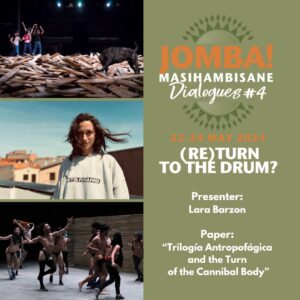
This paper references the choreography of Uruguayan Tamara Cubas (Trilogía Antropofágica-Anthropophagic Trilogy, 2017) as a case study in order to illustrate that indigenous cosmology may be employed not as a return to the past, but as a turn towards the liberation of bodies from domestication and commodification of desire. Drawing on Eduardo Viveiros de Castro’s anthropological studies on the cannibal practices of Amerindians, and Suely Rolnik’s reworking of Oswald de Andrade’s ‘Anthropophagic Manifesto’, I propose anthropophagy as an epistemology of the South that challenges notions of authenticity. Amerindian anthropophagy was indeed a complex ritual for relating to the ‘enemy’ with the aim to incorporate their perspective into one’s own identity through the act of cannibalism. Consequently, this questions concepts of identity and ethnocentrism, highlighting how the self is shaped by relationships. Trilogía Antropofágica arises from incorporating three Brazilian pieces through cannibalisation and serves as a tool for collective experimentation in creating a cannibal society where being affected by others is essential. The return is not toward dance technique or traditions, but toward the body’s ability to respond to vital impulses from both other human and non-human bodies. Lastly, I demonstrate how the outcomes of this process are chi’xi works and bodies, where chi’xi is an Aymara term introduced by Silvia Rivera Cusicanqui signifying mestizaje as vital coexistence amidst antagonisms, contradictions, and paradoxes.
Biography: Lara Barzon
Lara Barzon is an EUTOPIA co-tutelle PhD fellow with a joint PhD between Theatre and PerformanceStudies(UniversityofWarwick)andCulturalStudies(UniversityofLjubljana).Herresearchinterestiscontemporarydanceasaterrainofaestheticandpoliticaldecolonialexperimentation,withafocusonBraziliananthropophagyasastateof creationthrough otherness.As ascholar,sheis a teammemberoftheglobaldanceconferenceDancingwithDecolonisationandhascollaboratedwithinstitutions suchastheVenice DanceBiennaleandITEMMadrid, as wellastheproject PrecariousMovements:ChoreographyandtheMuseumsponsoredbytheUniversityNewSouthWalesincollaborationwith art galleriesaroundtheworld. Sheisalsoaperformanceartist,founderof‘SpazioLiquido: aspaceforcontemporarycreation’andco-founderofthetransnationalcollective‘lstmoNomade’,withwhichshecarriesonherdancepractice,workingmainlybetweenItaly,SpainandUruguay.