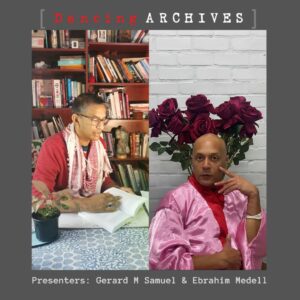
The tropes of the master and slave (and by extension servant and ‘merrim’ [Afri-Kaaps for madam]), ‘noble savage’ (Dixon Gottschild, 1996), queer readings in ballet (Feuer, 2001), and entanglement between activism and choreography (Kosstrin, 2017) serve as trigger points for a live viewing and discussion of eroding and evasive memories in South African Dance. Notions of the exoticised Other and surrounding mythologies of ‘natural rhythm’, and propensity to lasciviousness, for some, can be traced to a post Enlightenment era which in Cape Town stirs a murky colonial and apartheid past. This has been partially explored in some locally anchored ballets/dance works such as Kami (Poole, 1976), Mango Suite (Steyn, 1990s), The Wandering souls of Mendi (Rani, 2004) and Ingoma (November, M. 2021).
Death and the Merrim, a choreo-diary toys irreverently with misogyny and prejudice to highlight the insatiable appetite for brown dancing bodies. Tiny triplet steps for Chinese and languid, saffroned Arabians in The Nutcracker beware! How have brown bodies been produced and consumed in the world of ballet, and in South Africa? Two former professional, South African ballet dancers ‘reach back to look forward’ (Parker & Samuel, 2020) from the archive of their ageing bodies to excavate notions of (fr)agility and (in)dependence in dance. This triumphful ethno-drama negotiation underscores the layers of hybrid personas and congealed characters in Samuel and Medell’s combined repertoire of over fifty ballets/dance works since the mid-1980s. Co-navigating a dying swan metaphor we will agonise over the slow death of the object and subject of the powerful ballet ‘merrim’ to suggest new unities. Linguist Rajend Mesthrie suggests “Where [dance] language is concerned, diversity is all” (Mesthrie, 2011:149 [my insertion]). This clarion is extended here via our comparative choreopoem, if somewhat sideward glance.
Keywords: Brown bodies, privilege, archive, embodied memory, (fr)agility, (in)dependence
Biographies: Gerard Samuel & Ebrahim Medell
Gerard Samuel is an Associate Professor: University of Cape Town, Centre for Theatre, Dance and Performance Studies and Head of CTDPS Dance Section. He is the Convener: Post Graduate studies in Dance, Editor: South African Dance Journal, and Chair of Confluences a biennial, international dance conference hosted by UCT. During the Apartheid era he performed with the NAPAC Ballet Company and The Playhouse Dance Company in Durban. He held senior management posts for The Playhouse Company, until 2006. He is an advocate of disability arts in South Africa and in Copenhagen. His scientific focus area is Contemporary Dance in South Africa and the nexus it offers for reimagining notions of Other and Body. Through Post-colonial and phenomenological readings, I continue to investigate subfields of Dance discourse such as ballet, children’s dance theatre, dance as social healing, and performativity of the archive.
Ebrahim Meddel is and award winning dancer, and choreographer currently based at the Eoan Group in Cape Town where he began his journey. He has performed internationally (Paris, Rome, Budapest, Mumbai, and Tunis) and with numerous companies in South Africa including NAPAC Dance company, Bop Dance, PACT Ballet, and later the State Theatre Ballet. He also danced for Magic Life der Klub, Turkey. Ebrahim’s awards include the South African Airways Young Performer Award for Best Male Performer (1997), and the FNB Vita Award (1996). His most recent creative choreographic works include Dead Girls Dancing, Interrupted Mindfulness, and Shifting Dependencies. Ebrahim’s works have been part of the Baxter Dance Festival and Suidooster fes in recent years. He is also a sought-after ballet teacher currently sharing his experience and expertise at UCT School of Dance. Ebrahim is the Artistic Director of the Eoan Group Theatre co. and sums up his life journey as vivacious, “spray with Doom and start over”.