


Chair: Clare Craighead
PAPERS:
DIALOGUE / PAPER #1: “We need to talk about Giselle” – Dr. Sarahleigh Castelyn (University of East London, UK)
DIALOGUE/PAPER #2: “Reflection on SIBIKWA’s inaugural 2022 ‘Body Moves’ Festival” – Phyllis Klotz (SIBIKWA Arts Centre, South Africa)
Paper #1: “We need to talk about Giselle” – Dr. Sarahleigh Castelyn (University of East London, UK)
The ballet Giselle, premiered in 1841, choreographed by Marius Petipa after Jean Coralli and Jules Perrot, is a key work in ballet repertory with choreographers such as Dada Masilo, Akram Khan, and Mats Ek, and dance companies, namely Joburg Ballet, Birmingham Royal Ballet, and Dance Theatre of Harlem staging the work. This is a ballet that has reviews of productions stating that ‘[t]he work in itself is bipolar. The first act begins with two lovers prancing around a sunny village and ends with betrayal, a psychotic meltdown and Giselle’s death; Act 2 is danced at her gravesite’ (San Francisco Examiner, 2014) or ‘her descent into madness is one of terrible stillness followed by desperate jumps’ (Crompton, 2021). As a person with Bipolar, I am extremely frustrated with portrayals of and reference to madness or crazy, especially in dance. From the choreographer to the reviewer, we are all responsible and accountable for the proliferation of negative stereotypes of madness and thereby adding to the stigma of mental illnesses, such as Bipolar.
Recent campaigns have raised awareness of hidden disabilities and the importance of mental health care is stressed in the popular media, however disabilities such as Bipolar and Schizophrenia are still side-lined. There is very little recognition and understanding of the complexities of these disabilities. There are a few choreographers and/or dancers who live/lived with Bipolar, for example Alvin Ailey, and/or have created work about Bipolar, for example Welcome to Barrio Ataxia (2020) by Omar Román De Jesús, and there are Bipolar ambassadors, such as Emma Belle describing living with this disability as a dance. There is a ‘long and complicated relationship between madness and performance (Harpin and Foster, 2014: 4), and although recent productions of Giselle do approach the hetero-normative narrative and disrupt it with decolonial and feminist choreographic tactics, further ‘bodily analysis’ (Desmond, 1997: 33) in which the ‘ways of holding the body, gesturing, moving in relation to time, and using space (taking a lot, using a little, moving with large sweeping motions, or small contained ones, and so forth)’ (Desmond, 1997: 33) reveals how madness is perceived. In talking about Giselle, I must ask, what if Giselle is me?
Paper #2: “Reflection on SIBIKWA’s inaugural 2022 ‘Body Moves’ Festival’ – tracing legacies of integrated art practices” Phyllis Klotz (SIBIKWA Arts Centre, South Africa)
The Benoni based SIBIKWA Arts Centre, has a long history of supporting and nurturing community based integrated and disability dance, theatre and music initiaives. This paper/dialogues talks about this history that comes to fruition in the 2022 inaugural ‘Body Moves Festival‘. In negotiating this festival, this paper looks at how integrated and disability dance in Africa and more globally can begin to open space for real democratic dialogue around ideas of inclusivity; never forgetting the performative spaces of joy and transformation.

Sarahleigh Castelyn is a performer, choreographer, and researcher: a dance nerd. She is an Associate Professor/ Reader in Performing Arts in the School of Arts and Creative Industries at the University of East London (U.K.). Her dance research focuses on race, gender, sexuality, and nation in apartheid and post-apartheid South Africa, the politics of hybridity, and the use of practice as a research methodology. She has performed in and choreographed dance works, for example at JOMBA! Contemporary Dance Festival (SA) and Queen Mary (UK) She serves on several editorial and organisation boards, such as Research in Dance Education and HOTFOOT. She has published on dance and South Africa: in Viral Dramaturgies (2018), Narratives in Black British Dance (2018), her monograph Contemporary Dance in South Africa: The Toyi-Toying Body (2023), and in journals such as The African Performance Review, Dance Theatre Journal, Animated, African Performance Review, and The South African Theatre Journal.
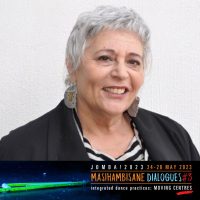
Phyllis Klotz is co-founder of the Sibikwa Arts Centre, she has been involved in development theatre in education for many years and is recognised as an expert in the development of community arts centres. She has toured South Africa extensively with plays dealing with a variety of topics. She is the recipient of several awards for her contribution to South African theatre and community development through the arts. Phyllis directed and co-wrote the seminal South African theatre piece ‘You Strike a Woman, You Strike a Rock’ and was voted one of the ten major contributors to the South African performing arts by the Star newspaper. She was instrumental in founding several community arts organizations amongst them the Gauteng Organisation for Community Arts and Culture Centres (GOMACC) and is the recipient of a Naledi Lifetime Achievement.